Democracy Notwithstanding
Normalizing the Nuclear Option: A Chronology of the Charter Override, 2000–Present

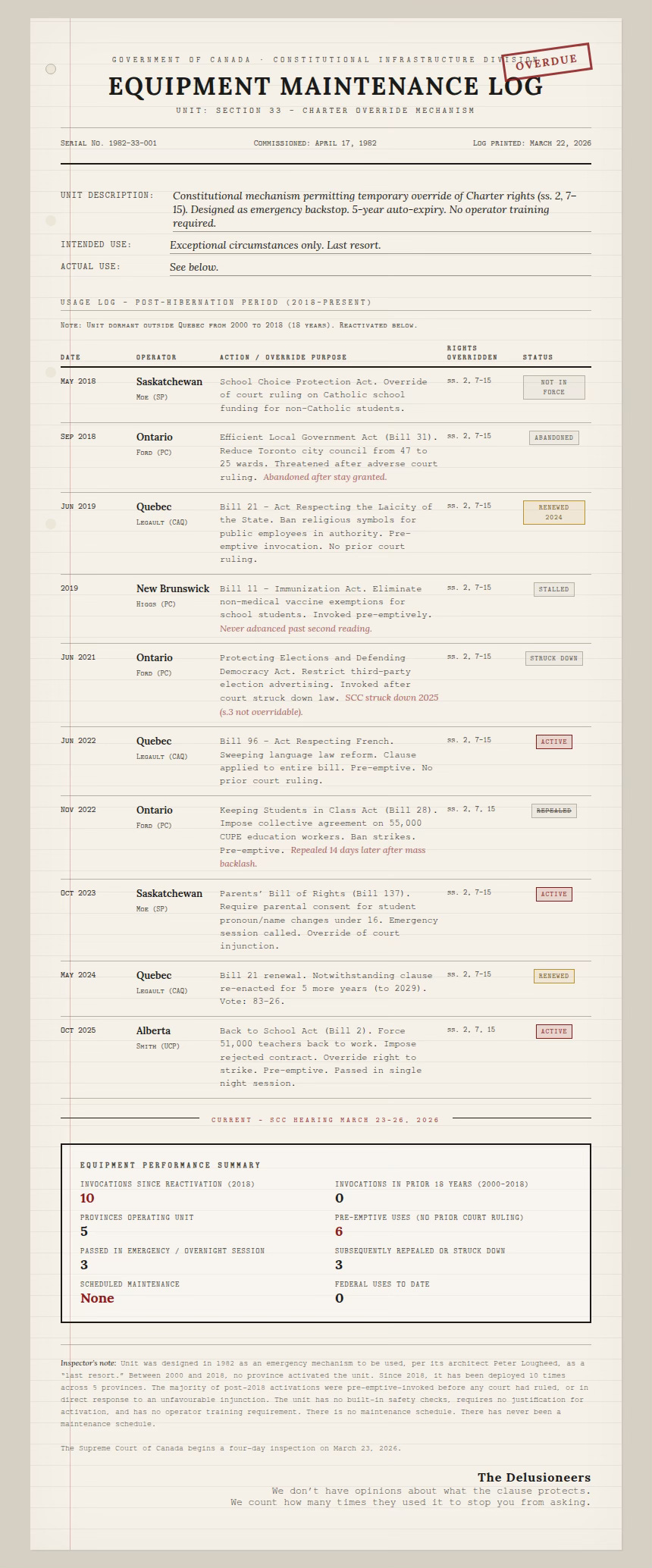
Section 33 of the Canadian Charter of Rights and Freedoms, better known as the notwithstanding clause, was added in 1982 as a compromise. Peter Lougheed, then Premier of Alberta, proposed it as an emergency backstop: a mechanism for elected legislatures to temporarily override certain Charter rights when courts got it wrong.
A last resort.
There is no manual for the mechanism. No justification is required for activation. No training. No review process. No inspection schedule.
There has never been an inspection schedule.
Between 2000 and 2018, no province activated it. Eighteen years of dormancy.
Since 2018, it has been activated 10 times across five provinces.
The log.
May 2018 — Saskatchewan (Moe). School Choice Protection Act. Override a court ruling on Catholic school funding. Never brought into force.
September 2018 — Ontario (Ford). Bill 31. Reduce Toronto city council from 47 to 25 wards. Threatened after adverse court ruling. Abandoned after the Court of Appeal granted a stay.
June 2019 — Quebec (Legault). Bill 21 — Act Respecting the Laicity of the State. Ban religious symbols for public employees in positions of authority. Pre-emptive. No prior court ruling. Renewed May 2024 for another five years.
2019 — New Brunswick (Higgs). Bill 11 — Immunization Act. Eliminate non-medical vaccine exemptions. Pre-emptive. Never advanced past second reading.
June 2021 — Ontario (Ford). Protecting Elections and Defending Democracy Act. Restrict third-party election advertising after the law was struck down. The SCC ruled in 2025 that the clause cannot override voting rights under s.3.
June 2022 — Quebec (Legault). Bill 96 — Act Respecting French. Sweeping language law reform. The clause was applied to the entire bill. Pre-emptive. No prior court ruling.
November 2022 — Ontario (Ford). Keeping Students in Class Act (Bill 28). Impose a collective agreement on 55,000 CUPE education workers. Ban strikes pre-emptively. Repealed 14 days later after mass backlash and a threat of a general strike.
October 2023 — Saskatchewan (Moe). Parents’ Bill of Rights (Bill 137). Require parental consent for student pronoun and name changes under 16. Emergency legislative session recalled. Direct override of a court injunction that found the policy could cause “irreparable harm.”
May 2024 — Quebec (Legault). Bill 21 renewal. Notwithstanding clause re-enacted for five more years, to 2029. Vote: 83–26.
October 2025 — Alberta (Smith). Back to School Act (Bill 2). Force 51,000 striking teachers back to work. Impose a collective agreement that the teachers had previously rejected. Pre-emptive. Passed in a single overnight legislative session.
The pattern.
Ten activations in eight years after an 18-year dormancy.
Six of the ten were pre-emptive. They were invoked before any court had ruled on the legislation.
Three were passed in emergency or overnight sessions.
Three have since been repealed or struck down.
The clause can override freedom of religion, freedom of expression, freedom of association, the right to strike, and equality rights.
It cannot override voting rights, mobility rights, or language rights.
That doesn’t mean it hasn’t been tried.
The inspection.
On Monday, March 23, the Supreme Court of Canada begins a four-day hearing on Quebec’s Bill 21. It is the most significant constitutional case since the 1998 Secession Reference.
The Court is going to examine whether there are limits to Section 33, or if the mechanism operates exactly as designed: without checks, without justification, without review.
Sixty-one intervening organizations have filed. The federal government has argued the clause cannot “annihilate” rights. Five premiers have urged the Prime Minister to withdraw his submission. He has not.
The mechanism was built in 1982. It has never been inspected.
The inspection runs from March 23 to March 26.
View case details here. (via the Supreme Court of Canada)
The Delusioneers don’t have opinions about what the clause protects. We count how many times they used it to stop you from asking.
Sources:
All entries sourced from legislative records, parliamentary proceedings, and reporting by CBC News, The Globe and Mail, Global News, and CTV News.
Comprehensive sourcing available on request.
The Caitlin Salvino monograph The Notwithstanding Clause in the Canadian Charter of Rights and Freedoms (UTP, 2025) provides the most complete academic record of Section 33 invocations.